








































The textile industry is one of the world’s most carbon-intensive industries, yet the trajectory shows significant overshoots of the set global climate targets and commitments. Given the urgency of limiting global warming to 1.5 degrees Celsius, building a credible, reliable, and data-backed roadmap for the sustainable textile industry’s decarbonization is no longer optional; it has become a strategic decision for achieving a sustainable textile industry.
Why is Textile Industry Decarbonization Crucial?
The global fashion and textile industry was responsible for around 2.1 billion MT of greenhouse gas emissions in 2018, accounting for around 4% of total emissions. The textile industry’s carbon emissions are equivalent to the total annual emissions of France, Germany, and the United Kingdom. A record-breaking material production was made in 2024, reaching 132 MMT for all markets, up from 125 MMT in 2023, equivalent to producing 4 tonnes of fibre every second, fuelling the amount of greenhouse gases in the atmosphere. Cotton, being the second most produced fibre in the world, its share in the global market declined by 1% to 19% in 2023-24.
The textile industry emissions are driven by increased production of apparel, such as fast fashion, and a high reliance on virgin polyester. The total throwaways generated through fast fashion textile waste are estimated to be 92 MMT globally every year and are expected to rise to 134 MMT a year by 2030. The industry also generates around 20% of global wastewater by releasing 93 billion cubic meters of wastewater from dyeing textiles.
The UNFCCC’s Fashion Industry Charter for Climate Action, 2018, aims to promote textile industry decarbonization, achieve net zero textile industry emissions by 2050. The charter also targets to halve emissions by 2030 compared to the 2019 level, in line with keeping the global warming level below 1.5 degrees Celsius from pre-industrial levels set out during the Paris Agreement, for paving the path for a sustainable textile industry.

Despite the strong global commitments, the textile industry’s carbon emissions are on a continuous rise. As per the Textile Exchange’s 2025 Materials Market Report, the GHG emissions from raw material production for textiles, apparel, home textiles, and footwear increased by 20% between 2019 and 2024. The Apparel Impact Institute in 2023 recorded a 7.5% year-on-year increase in these sectors’ emissions. These emissions are far more than the aggregated emissions of the aviation and shipping sectors globally, which means that the fashion and textile industry emissions are a major contributor to global warming.
Textile Industry Carbon Emissions Current Profile
The value chain emissions of the textile sector are spread across raw materials, manufacturing, processing, transport (upstream and downstream), retail sales, and end-of-life emissions. The UNFCCC Fashion Charter’s 2023 report shows that the Scope 3 emissions are 11 times higher than the company’s Scope 1 and 2 emissions combined.
The following key hotspots were identified as significant contributor to the overall emissions:
Polyester production, which is the largest contributor with around 43% of the total GHG impact from raw material due to high production volume. The fossil fuel-based polyester continues to share around 59% of the total global fibre output, of which approximately 88% is based on fossils.
The current level of textile-to-textile recycling remains lower at less than 1% for all fibres. The raw materials extraction contributes significantly to rising textile industry carbon emissions; hence, recycling is vital to reduce those emissions in the future. A sustainable textile industry set up is crucial to meet the current commitments and become net zero textile industry.
Textile Industry Carbon Emissions Trajectory Under Current Global Commitments
Based on the report submitted by 21 UNFCCC fashion charter signatories who have committed full emissions pathways, aggregated scope 1 and scope 2 emissions are projected to reduce by 47% from 2023 to 2030, while scope 3 emissions are expected to decrease by less than 32% from 2023 to 2030. The existing gap between scope 1 and 2, and scope 3 depicts that the supply chain textile decarbonization still remains a critical challenge that needs to be addressed to cut down the textile industry carbon emissions globally and make it a sustainable textile industry, along with net zero textile industry.
How can Companies Build a Strong Textile Decarbonization Roadmap for Themselves?

Related Read: Why Supplier ESG Is Becoming a Business Imperative
For building a strong textile industry decarbonization roadmap, a phased and data-driven approach is required that can address the existing gaps in technology, investment, and policy. The report shows that many brands and manufacturers are making good progress in decarbonizing their supply chains and energy use. The framework given by WRI and AII suggests that for the textile industry to achieve decarbonization and reduce its carbon emissions aligned with the global target of a 1.5-degree Celsius trajectory, it needs to take certain actions as listed below.
Improving Material Efficiency
Utilizing good quality fabric, sourcing raw material from certified sustainable vendors, minimizing fabric waste production through cutting, optimizing designs, and managing overproduction. Reports show that the use of virgin fossil-based polyester decreased from 637,388 tonnes in 2023 to 560,029 tonnes in 2024. With this, the share of brands implementing measures for reducing negative impacts on the environment during various stages has increased from 77% in 2023 to 81% in 2024.
Promote Sustainable Materials and Practices
Including transitioning to lower-impact fibres, using certified organic cotton, and recycling polyester. Although the share of raw materials certified under sustainability programs has increased from 58% in 2023 to around 67% in 2024, the same should continue in the future. Fast-tracking the creation of innovative products and materials by investing in next-generation fibres, using low-climate-impact materials like cotton, wool, and introducing closed-loop recycling technologies can help reduce the textile industry carbon emissions.
Energy Efficiency and Innovations
Improving energy efficiency in production processes by implementing waste heat recovery systems, waterless dyeing, and advanced process control measures in manufacturing facilities. Eliminating the use of fossil fuels like coal-fired boilers, coal-fired heat and power generation, diesel run machines in all the owned and supplier facilities by 2030 will lead to building a sustainable textile industry.
Renewable Energy Adoption for Electricity Generation
Transitioning to 100% renewable electricity generation means sourcing renewable energy throughout the supply chains. Following these steps will ensure achieving over 60% of the textile industry carbon emissions to remain aligned with the global commitment and target of 1.5 degrees Celsius.
Disclosing Transparent Brand Commitments
Various brands, retailers, and their subsidiaries are actively replacing their conventional raw materials with certified sustainable sources to avoid high-risk sourcing areas for natural fibre and are also reducing the use of virgin fossil-based polyester in their production processes to avoid any legal liabilities, financial losses, or reputational damage.
The percentage of brands coming up with formal climate targets rose from 85% in 2023 to 88% in 2024. Hence, incorporating measures for a sustainable textile industry must be promoted.
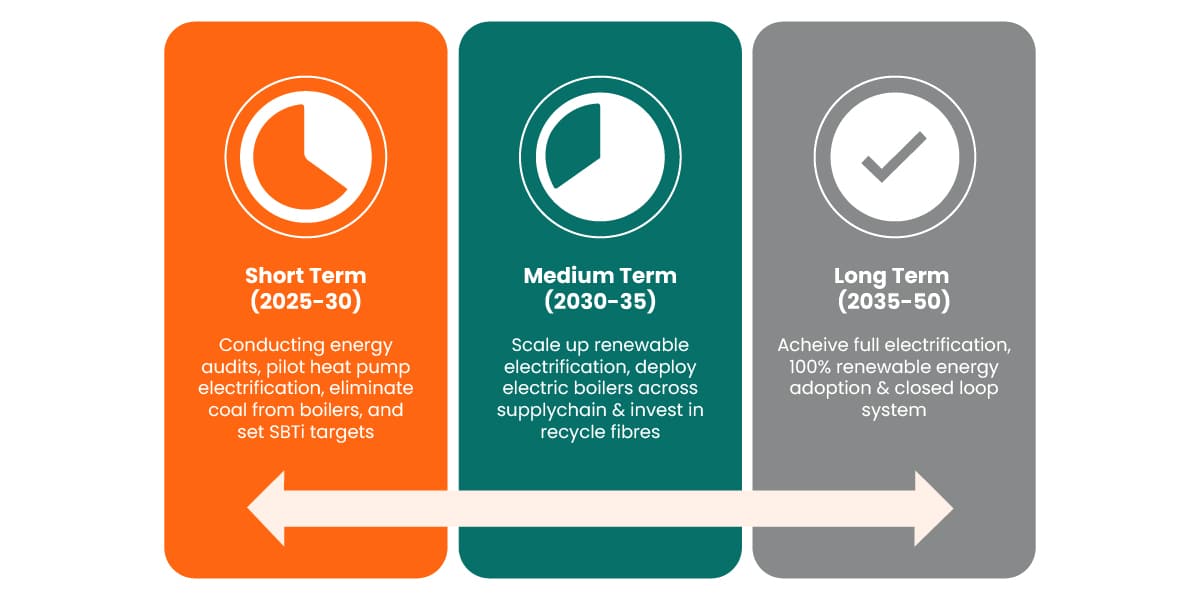
Roadmap to achieve sustainable textile industry
Conclusion

The current business models and solutions are not sufficient to achieve the textile industry decarbonization roadmap and climate goals to avoid a climate catastrophe. The industry needs to adopt bigger, more systematic change and scaling up of low-carbon solutions. Despite the growing emissions from textile and apparel companies and manufacturers, efforts are being made by them to scale up their textile decarbonization roadmap through strong investments and climate commitments.
Reducing textile industry carbon emissions and achieving a decarbonization roadmap requires strong participation, momentum demonstration towards collective accountability, and creating new opportunities and solutions for building collaboration and partnerships.
Brands must start transparently reporting their emissions and progress for recognition and to attract strong customer trust. This will help track industry progress for decarbonization and provide credible verification mechanisms.
Why Choose Ascentium?
Clients should choose Ascentium for various sector decarbonization projects, including power, cement, steel, chemicals and textiles, as we deliver end-to-end solutions from data collection, setting boundaries, preparing GHG inventory, emission calculation, emission reduction initiatives, providing tailored net zero, decarbonization roadmaps, and policy-aligned strategies. Ascentium stands out for solutions that turn regulatory compliance into competitive advantages, backed by content creation prowess for stakeholder reporting and green financing pitches. If you have any questions or require assistance regarding our process, please write to us at in-info@ascentium.com or reach out to us via WhatsApp at (+91) 77380 66622.