









































Succession planning is essential to preserve one’s legacy and ensure a smooth, structured transfer of assets to future generations. It also helps provide financial security to the intended beneficiaries. Failing to plan succession through available instruments leaves an individual with no choice and discretion over distribution of assets. It then leads to distribution as per applicable succession laws in India which vary based on religion and gender.
Following are the succession laws applicable based on religion:
| Religion | Succession law applicable |
| Hindus, Buddhists, Jains, and Sikhs | Hindu Succession Act, 1956 |
| Muslims | Sharia-based personal laws |
| Christians and Parsis | Indian Succession Act, 1925 |

Post the landmark amendment in 2005, under Hindu Succession Act 1956, daughters whether married or unmarried, were granted an equal right to become coparceners and entitled to receive an equal share in Hindu Undivided Family (HUF) along with men. However, when it comes to succession, women are not placed on an equal footing with men as rules governing intestate succession differs for men and women.
How estate gets distributed for Hindu women under the Hindu Succession Act 1956 (the Act)?
When an individual passes away “intestate,” it means they have died without leaving a valid, legally enforceable will. In such cases, the deceased loses the ability to direct the distribution of their estate, leaving the transfer of assets entirely to the statutory default rules defined by personal law.
Under the Hindu Succession Act, these rules are particularly nuanced for female Hindus passing away intestate. The distribution of property is not uniform; instead, the law mandates a specific, preferential order of devolution that shifts significantly depending on the source of the assets.
The distribution follows a distinct preferential order, which is outlined below:
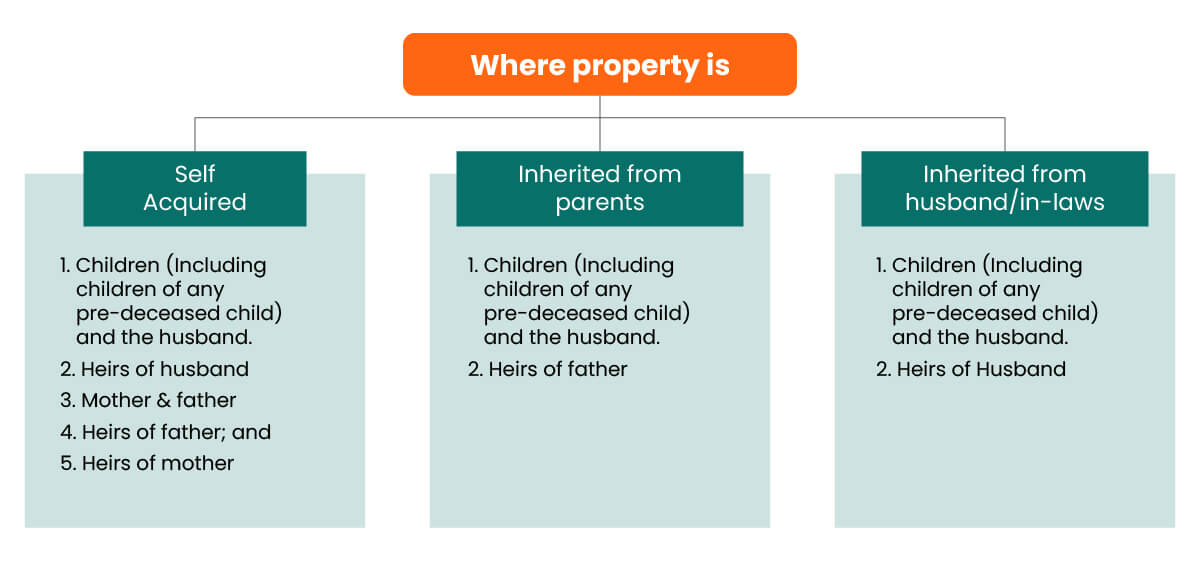 Under the Hindu Succession Act, the rules of succession often lead to outcomes that contradict the natural expectations of a family. For example, if a married Hindu woman passes away intestate, her self-acquired property does not automatically revert to her natal family. Instead, the statute prioritizes her marital family, specifically her children and husband, followed by her husband’s heirs, which means that even if she is an only child, her parents may be bypassed in favor of her in-laws.
The source of the property further complicates this hierarchy:
- Property Inherited from Parents: If a woman dies intestate, assets she inherited from her parents do not pass to her own heirs. Instead, the law mandates that such property devolves to the heirs of her father. Notably, this applies even to property inherited from her mother; under the Act, such assets are still channeled through the father’s line of succession rather than the mother’s.
- The “In-Law” Priority: The statutory framework effectively grants the marital family a superior claim over the natal family for most classes of property. Because these default provisions prioritize the husband’s lineage, the parents of a deceased Hindu woman often find themselves excluded from inheriting her estate, regardless of the property’s original source.
This statutory bias highlights the critical need for comprehensive estate planning. Without a formal will or structured legacy plan, the law imposes a rigid distribution scheme that may alienate a woman’s assets from her own natal family, regardless of her personal wishes or familial relationships.

Related Read: Are Nominations Enough for Succession: Explained
The judicial interpretation of these rules further confirms their rigidity, as seen in Omprakash & Ors. Vs. Radhacharan & Ors. [2009] INSC 899 (May 5, 2009). In this case, even though Narayani Devi died intestate and without children and had lived with and supported her parents after her husband’s death, the Supreme Court ruled that her self-acquired assets must devolve upon her husband’s heirs and not her parents. This landmark decision highlights that, in the absence of a will, the law ignores personal circumstances, strictly prioritizing the marital lineage over the natal family.
The Role of a Will in Succession Planning
The legal inconsistency can result in disputes between two families. However, to pass on property to her parents instead of letting it pass to the legal heirs of husband, succession planning is indispensable. Succession planning helps an individual to define the manner and the people to whom the estate will be distributed. A duly executed, registered and valid testamentary instrument (Will) is in existence, the devolution of estate shall be governed strictly in accordance with the disposition contained therein. Accordingly, rules of intestate succession shall not apply in such case.
Further, if a woman is married or getting married, it is important to identify her ‘streedhan’ (assets, movable or immovable, received as gifts before, during or after marriage) and record it separately in the Will.
However, in any case where no Will is maintained by a Hindu woman, property acquired by herself or received as gift etc., the same will be distributed in the preferential order given in the succession laws, irrespective of her preference in passing such property.
Considering issues under the Hindu Succession Act, the Supreme Court of India in recent hearing has urged to all women especially Hindu women to make a Will irrespective of age or the amount of wealth accumulated. This is to ensure the property gets distributed as per their wishes and avoids possible disputes between both family members.
Conclusion

Related Read: RBI’s New NBFC Rules for Family Investment Structures
For Hindu women, the rules of intestate succession are extremely unfavorable, the heirs of her husband are given preference over her own parents and other family members. This can be avoided or altered by putting in place a Will that states how her assets or estate would need to be dealt with upon her death.
Women must realize the importance of estate planning and the need to start the discussion regarding the same at an early stage. Relying on intestate laws or on her relatives will not produce the best outcome.
In purview of the legal anomalies around the statutory framework for intestate succession of Hindu women, absence of a Will or any other succession instrument may lead to unfavorable outcomes. It therefore becomes non-negotiable for women to consider succession planning through a strategically drafted Will or a Private trust.
Why Choose Ascentium?
At Ascentium, our dedicated team of succession planners understand the roots of a family and the values that drive the legacy forward. We plan succession for families holistically to avoid any legal loopholes and secure wealth for future generations. Our dedicated team of succession planning experts includes legal professionals, tax and financial advisors. To learn more about our services, please email us at in-info@ascentium.com or reach out to us via WhatsApp at (+91) 77380 66622.