








































The growing focus on ESG disclosures in India has also increased the need for consistent, reliable, and verifiable sustainability information.
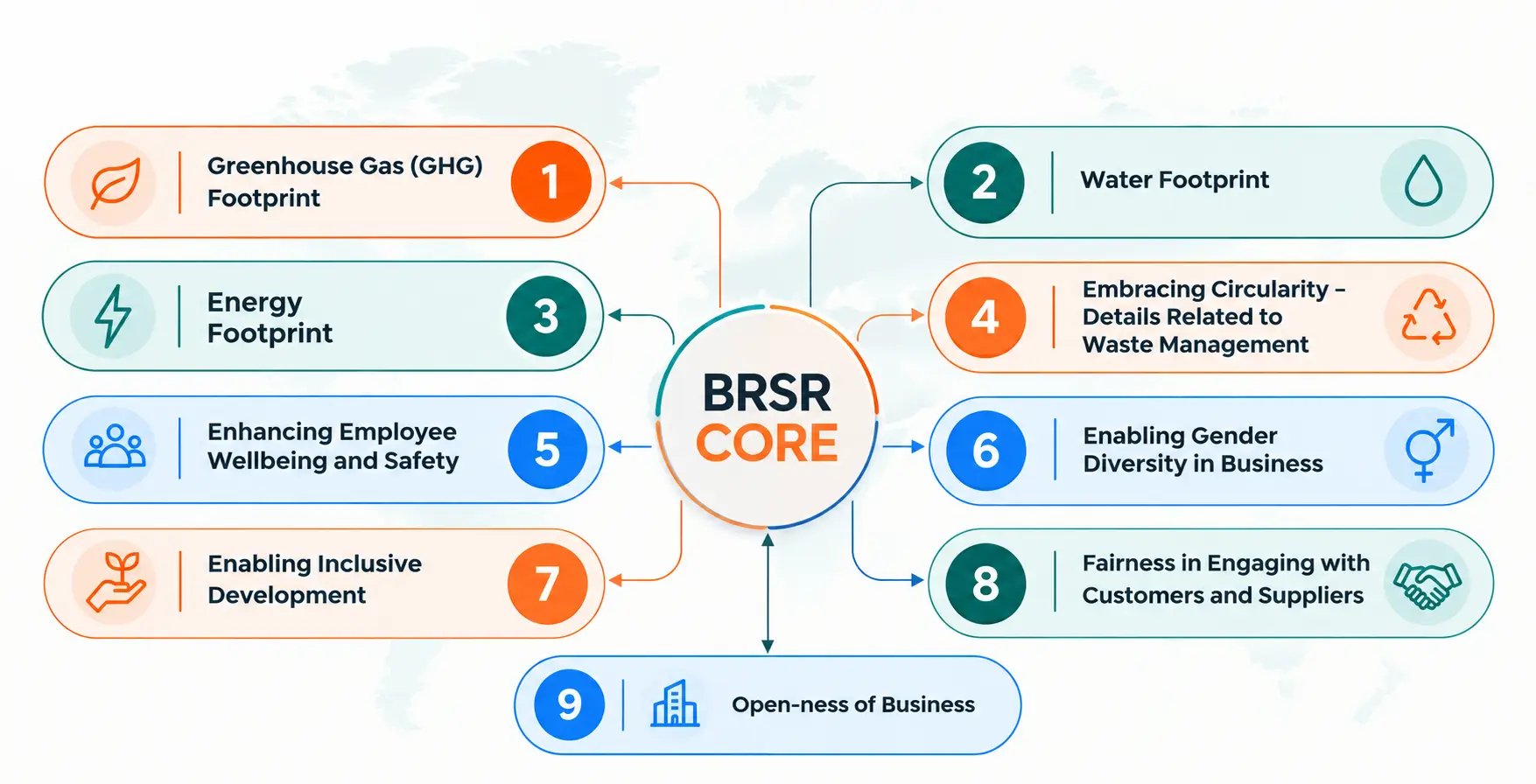
The SEBI BRSR framework introduces BRSR Core, providing a focused approach to BRSR reporting including nine key parameters. These increasing reporting requirements also create a need to verify the accuracy of such reports for decision-making.
This is where assurance comes into the picture. It examines BRSR reports, enhancing credibility and providing stakeholders with greater confidence in the disclosures.

Related Read: EU PPWR: The Global Evolution of Packaging Regulation
Understanding BRSR Core
BRSR Core is a subset of BRSR containing selected Key Performance Indicators (KPIs) and metrics across nine ESG attributes as prescribed under the SEBI LODR Regulations. In simple terms, a SEBI BRSR discloses ESG information of companies, while BRSR Core identifies a focused set of specific ESG parameters.
Types of assurance and how they differ from assessment
- External assurance External assurance is performed by an independent assurance provider and generally lends greater credibility to ESG disclosures. It can be performed at two levels:
- Limited assurance: Involves comparatively limited testing and procedures and offers a moderate level of assurance on the reported information.
- Reasonable assurance: Involves more extensive testing, evidence gathering and evaluation Thus, giving a higher level of assurance. However, it does not provide absolute assurance.
In a nutshell, limited assurance checks whether the information looks right, whereas reasonable assurance verifies the evidence supporting it.
- Assessment
Under the revised BRSR Core framework introduced by SEBI BRSR regulations, listed entities may also undertake an assessment as an alternative to assurance. As per the definition prescribed by SEBI, an assessment refers to third-party verification conducted as per standards developed by the Industry Standards Forum (ISF) in consultation with SEBI. - Internal assurance
Internal assurance involves the examination of ESG data, reporting processes and internal controls by the organisation’s internal teams. It helps companies identify gaps in data collection, documentation and reporting before the disclosures are subject to external review.
Applicability of BRSR Core Assurance or Assessment as of FY 2025-2026
As per the revised framework issued in December 2024, the SEBI BRSR requirements mandate listed entities to undertake assurance or assessment of the BRSR Core in accordance with the glide path specified below:
| Financial Year | Applicability based on market capitalization |
|---|---|
| 2023-24 | Top 150 listed entities |
| 2024-25 | Top 250 listed entities |
| 2025-26 | Top 500 listed entities |
| 2026-27 | Top 1000 listed entities |
It is important to note that the companies falling within the above glide path have the option to choose between assurance (either reasonable or limited) and assessment of the BRSR Core.
The companies that do not fall within the top 1000 listed entities can voluntarily undergo reasonable, limited or internal assurance. Companies that fall within the top 1000 listed entities, however, must undergo third party assurance or assessment.

Who Can Provide BRSR Core Assurance?
Assurance of the BRSR Core is profession-neutral and need not be undertaken by a chartered accountant. Under the SEBI BRSR framework, the board of the listed entity shall ensure that the assurance provider appointed for assuring the BRSR Core has the necessary expertise for performing reasonable assurance.
The BRSR Core Assurance Process
Now, we shall discuss the scope of work under reasonable, limited and internal assurance to understand the key differences in the procedures performed under each category of assurance.
| Particulars | Reasonable assurance | Limited Assurance | Internal Assurance |
|---|---|---|---|
| Primary Focus | This type of assurance involves a more extensive and detailed verification of ESG information. | This type of assurance generally involves selected procedures and inquiries with a limited level of verification. | The focus remains largely on the organisation’s internal processes and controls. |
| Supporting evidence and records | Includes the process of verifying supporting evidence. | Limited assurance involves verification of less data and evidence on a sample basis. | Internal assurance mainly focuses on reviewing whether supporting documents are maintained properly. |
| Understanding and testing of ESG information | This involves obtaining a detailed understanding of the report and performing in-depth testing of ESG information. | This involves very limited testing of evidence and records as well as an analytical review of information. | Reviews how ESG information is sourced from different departments and whether the calculations and records are accurate. |
| Site visits and other procedures | Includes site visits and performing additional procedures if required. | Additional procedures may be performed where required based on the review. | Reviews whether the company has processes to identify and correct errors. |
| Final report | A reasonable assurance report expresses a positive form of conclusion stating that, in the practitioner’s opinion, the subject matter is in accordance with the applicable criteria in all material aspects. | A limited assurance report expresses a negative form of conclusion, stating that nothing has come to the practitioner’s attention that causes them to believe the subject matter is not in accordance with the applicable criteria. | An internal review report is prepared for management and the board of directors, highlighting findings, gaps and recommendations. |
Assessment
This type of examination is different from the above-mentioned types of assurance. Broadly, an independent third party examines the ESG information. However, the guideline for assessment is not yet issued by Industry Standards Forum (ISF).
What Should Companies Consider?
In our view, companies should look beyond treating BRSR Core assurance as a mere regulatory requirement. While the revised framework provides flexibility in selecting the appropriate approach. However, companies should also consider the maturity of their data and internal controls, as well as stakeholder expectations. A confident assurance approach, backed by reliable internal processes, can help companies improve data quality and build greater credibility.
The best solution would be for companies in the initial stages of implementing the applicability framework may begin with assessment or limited assurance approach and gradually transition to reasonable assurance process. However, companies already following reasonable assurance approach are encouraged to continue with the same to maintain the consistency in flow of their assurance practices.
Regulatory Framework for Sustainability Assurance in India

Related Read: Why Supplier ESG Is Becoming a Business Imperative
- Existing Standards: The sustainability assurance standards which are currently in practice includes SSAE 3000 (India) and ISAE 3000 (International). Additionally, GHG assurance is guided by SAE 3410 (India) and ISAE 3410 (International)
- New Standards: The IAASB introduced ISSA 5000 for supporting both limited and reasonable assurance across sustainability topics. ISSA 5000 (International) will be effective from December 15, 2026, and ICAI introduced SSA 5000 (India) which aligns with ISSA 5000 and incorporates India specific provisions. This will be applicable on the reporting periods from April 01, 2027 onwards.
- Replacement of Existing Framework: ISSA 5000 replaces ISAE 3000 while SSA 5000 replaces SAE 3000 for sustainability engagements. However, ISAE 3410 and SAE 3410 will be withdrawn after enforcement of new standards respectively.
Conclusion: The Road Ahead
The implementation of BRSR Core assurance marks an important step towards transparency and reliability of ESG disclosures reported by companies. However, like every evolving framework, the assurance of BRSR Core also faces certain challenges. Nevertheless, as the Indian corporates continue to adapt to the growing focus on sustainability, BRSR Core assurance is expected to play an essential role in strengthening the trust of stakeholders and aligning Indian businesses with international sustainability objectives.
In our view, the companies can start preparing themselves for the coming reporting period by conducting assurance or assessment on relevant levels which is best suited for the organisation and keeping value chain disclosures in mind.
Why Choose Ascentium India?
We at Ascentium India provide services relating to ESG and risk management all under one roof. Our experienced team undertakes comprehensive assessments to identify potential ESG-related risks and opportunities. With our customised solutions we enable businesses achieve sustainability goals. To learn more about our services, please email us at in-info@ascentium.com or reach out to us via WhatsApp at (+91) 77380 66622.