









































ESG is no longer just a ‘supplemental feature’ for a company, it has become a core strategic pillar for value creation. One must measure, manage, and transparently communicate the ESG performance that has significantly increased amid investors’ interests. This shift has brought multiple regulatory mandates into existence, which continues to rapidly evolve across jurisdictions. For example, in India, top 1000 listed companies must divulge ESG performances under the Business Responsibility and Sustainability Reporting Framework, as mandated by SEBI.
Similarly, the Corporate Sustainability Reporting Directive (CSRD) by the European Union is expected to impact approximately 50,000 companies globally, including non-EU organisations. Moreover, frameworks such as the ISSB’s IFRS S1 and S2 standards are gaining traction across Asia, the Middle East, and the Americas, while climate disclosure expectations in the United States continue to evolve amid ongoing regulatory uncertainty around the SEC’s climate disclosure rules.
While the frameworks are being adopted rapidly, one of the key drivers behind this adoption has turned out to be investors’ growing expectations. According to recent sustainable investment surveys, a significant majority of asset owners consider climate change a key investment concern, with most integrating sustainability factors into investment decisions. This heightened investor focus has given companies a reality check as they now need to move beyond fragmented and inconsistent disclosure and adopt a standardised reporting framework that ensures comparability, reliability, and transparency.
To meet such expectations, the organisations around the world are turning towards frameworks with proper structure and guidance for ESG-related disclosures. In this context, the Global Reporting Initiative (GRI) has emerged as one of the most widely used and globally recognised frameworks for sustainability reporting. The Global Reporting Initiative (GRI) was established in 1997 and launched its first set of formal standards and guidelines in the 2000 for sustainability reporting.
Strategic Advantage of GRI Reporting
The question, then, is what compels a company to choose GRI standards as its sustainability reporting framework. Listed are some of the reasons:
- GRI Standards bring much-needed structure to sustainability disclosures, ensuring consistency across companies, sectors, industries, and geographies, something that has historically been difficult to achieve.
- GRI Standards make it genuinely easier for stakeholders to compare and evaluate ESG performance across organisations than trying to make sense of incompatible disclosures.
- GRI Standards help organisations stay aligned with evolving regulatory requirements and investor expectations, which is increasingly becoming non-negotiable for large businesses operating at scale.
- The GRI Standards keep organisations honest about what matters most, with a sharp focus on materiality to ensure disclosures reflect environmental, social, and economic impacts.
- GRI Standards are designed with all stakeholders in mind, not just investors, but acknowledging the legitimate interests of regulators, customers, and the communities that organisations are part of.
Understanding the Architecture of GRI Standards
To comprehend as to how the GRI reporting framework can be used for sustainability reporting, a quick guide to the GRI standards is provided below:
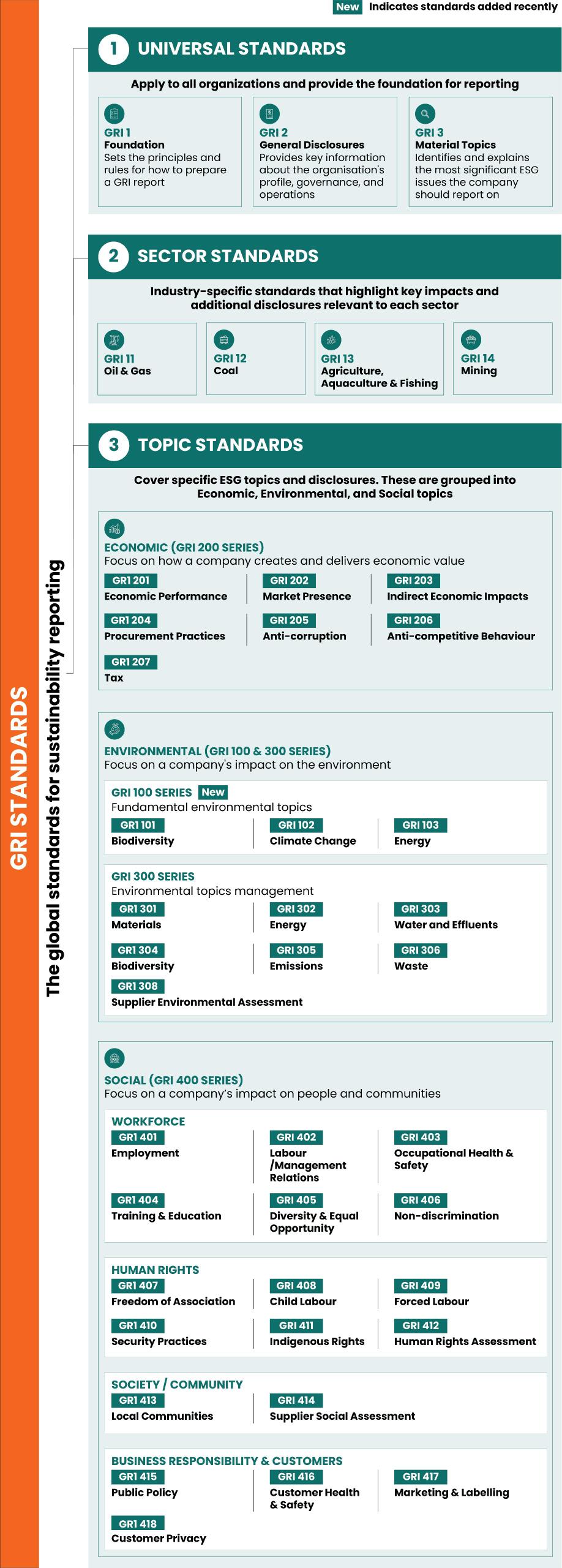
GRI Standards are categorised into three primary pillars:
1. Universal Standards
These standards define how to prepare the report according to a company’s context, and what topics matter most to it. These are further divided into three sub-standards: GRI 1, GRI 2, and GRI 3. The universal standards cover the fundamental requirements of GRI reporting, which include how an organisation should prepare reports, disclose general organisational information, and identify material topics and their management.
2. Sectoral Standards
The Sectoral GRI standards showcases industry-specific impacts and additional disclosures relevant to that sector, and they list the most significant issues specific to four particular industries: GRI 11: Oil and Gas, GRI 12: Coal, GRI 13: Agriculture, Aquaculture and Fishing, and GRI 14: Mining (2024), being the new addition to the Sectoral standards.
3. Topics Standards
These Topic standards define what specific ESG data and disclosures must be reported for each topic that is material for a company. Now, these standards are categorised into three sections: Economic, Environmental, and Social.
Let’s dive deep into it further:
- Economic Section (GRI 200 series): Focuses on the economic performance and impacts of an organization, covering areas like economic value creation and distribution, market presence, procurement practices, taxations, and ethical business conduct including anti-corruption and fair competition.
- Environmental Section (GRI 300 Series): This section explains how a company impacts natural resources, ecosystems, and the environment. This sector currently covers topics such as materials, energy, water and effluents, biodiversity, emissions, waste, and supplier environmental assessments. Under the environment sector, three new standards have been introduced recently:
- GRI 101 Biodiversity (2024) is a replacement of GRI 304 Biodiversity (2016). In this upgraded version, the organisations are required to assess and disclose their impacts, risks, and dependencies on ecosystems across their value chains.
- GRI 102 Climate Change (2025) enables organisations to report on their most significant climate impacts, their mitigation actions, and their management approaches to build accountability.
- GRI 103 Energy (2025) addresses energy usage in detail, including details about fuel, electricity, heating, cooling, and steam.
- Social Section (GRI 400 Series): This section explains how a company impacts people, including employees, communities, and customers. Now, to understand this section in a better way, it can be further divided into different brackets, based on who is getting affected and the type of impacts. Below are the four groups:
- Workforce: The standards cover all the employee-related aspects, like employment, safety, training, and diversity.
- Human Rights: Topics such as protection of fundamental rights like freedom of association, prevention of child/forced labour, and respect for indigenous rights are all being covered by the standards.
- Society/Community: These standards cover the assessment of the social practices within the supply chain, along with the engagement and development of the community.
- Business Responsibility & Customers: These standards cover the responsibility towards customers, including product safety, marketing practices, and data privacy.
Pictorial Representation of GRI Standards Framework for Sustainability Reporting
Bringing GRI Standards into Practice
A step-by-step implementation guide for GRI Reporting:
- Conducting Materiality Assessment (MA)
GRI reporting follows a materiality–driven approach, where organisations are required to focus on the ESG-related topics that are most relevant to their business operations and stakeholders. Begin by consulting the internal and external stakeholders to identify, assess, and prioritise those material topics that have significant environmental, social, and economic impacts on the company. - Identifying applicable GRI standards and relevant disclosures
Based on the results of the materiality assessment, determine which GRI standards and disclosures apply to the organisation. Assess whether any GRI Sector standard applies to industry and align the identified material topic with a corresponding topic standard. - Align reporting requirements with operational realities
Align the GRI disclosure requirements against actual business operations, procedures, and ESG impacts. Disclosures that are not material to the organisation can be removed to ensure relevant, focused, and practical reporting. - Establish robust data collection frameworks
Move to the implementation phase of reporting, where a structured data collection method needs to be established. Coordinate with different departments and to ensure they understand what is required and how to go about it. - Strengthening internal governance for ESG reporting
Effective sustainability reporting requires strong governance mechanisms. Companies can strengthen internal governance by clearly defining reporting responsibilities, review mechanisms, and approval processes to improve reporting accountability and reliability. - Develop a structured sustainability narrative
Once data systems are in place, the organisations should present relevant data in a consistent, precise, and standardised manner, generating a well-structured Sustainability Report that transparently communicates the organisation’s performance, priorities, and long-term commitments. External consultants or reporting experts may be engaged, where required, to support this process.
Conclusion
Sustainability reporting has become one of the most critical and demanding responsibilities for organisations in today’s progressing industry landscape. Given the continuously evolving nature of GRI Standards, keeping pace with the updates can be complex and resource-intensive while ensuring data accuracy, high-quality disclosures, and regulatory alignment.
Why Choose Ascentium?
Our team brings proven proficiency backed by a team of 30+ GRI-certified professionals and has supported the development of over 150 sustainability and ESG reports across more than 20 sectors. We offer practical expertise in addressing the challenges organisations commonly face in delivering report.
From designing effective data collection frameworks to refining disclosures, we work closely with our clients at every stage of the reporting process because we believe that the difference between basic compliance and truly credible reporting lies in careful execution and attention to detail. Write to us at in-info@ascentium.com or reach out to us via WhatsApp at (+91) 77380 66622 and strengthen your sustainability reporting journey with the expertise, structure, and strategic guidance needed to build credible, future-ready disclosures.