






































For decades, packaging materials were treated as waste. The regulations focused on what happens to packaging ‘after’ use, that is, collection, sorting, and disposal of the packaging waste. This approach, however, is currently undergoing a major transformation – gravitating towards preventing waste rather than managing it. Regulators are now focusing upstream, asking a much harder question – ‘How is the packaging designed in the first place?’ The newly introduced EU Packaging and Packaging Waste Regulation (EU PPWR), applicable from August 12, 2026, is the clearest expression of the latest shift. It will affect all packaging suppliers, manufacturers, producers, retailers, and waste management companies for packaging made from any material placed on the EU market. For business leaders, this shifts packaging from an operational decision to a strategic issue.
EU Packaging and Packaging Waste Regulation: Understanding the Framework

The EU Packaging and Packaging Waste Regulation is a more comprehensive framework, covering the lifecycle of packaging material, from substance restrictions, recyclability, recycled content, and minimisation to labelling, reuse, and producer responsibility. Its reach is broader as it applies to all packaging placed on the EU market. Companies outside the EU will be affected, either directly or through the customers and supply chains they serve.
The EU Regulation 2025/40 is supported by the following key pillars:
Waste Prevention and Minimisation
The regulation aims to make supply chains more sustainable and reduce packaging waste at source by minimising unnecessary and excessive packaging material.
Graded Recyclability and Recyclability at Scale
Packaging must be designed with end of life in mind. The packaging material will be assigned grades like A, B, and C, depending on recyclable mass. Anything below grade C will be banned by 2030. The vision shifts from packaging material being theoretically recyclable to being practically recycled ‘at scale’ using established European infrastructure.
Recycled Plastic Packaging Content
The new framework establishes a legal minimum threshold for Post Consumer Recycled (PCR) content in plastic packaging. It necessitates transparency for sourcing, procurement, traceability, and supplier documentation. It is not enough to use recycled content; businesses must back claims with evidence.
Reuse and Refill
The EU Regulation 2025/40 reflects the growing conviction that recycling alone is not enough. It prioritises keeping packaging material longer in circulation through reuse and refill.
Restrictions on Certain Packaging Formats
There is a ban on certain packaging materials containing toxins, including non-polymeric PFAS. The changing regulatory landscape requires businesses to review existing packaging portfolios now rather than face regulatory violations later.
Labelling, Packaging Information, and Traceability
The EU Packaging and Packaging Waste Regulation aims to harmonise packaging information and data for effective compliance and recycling. Good packaging data is becoming as important as a good packaging design.
Why EPR is not Enough: Why the EU Introduced the EU Packaging and Packaging Waste Regulation
A question that surfaced after the EU Regulation 2025/40 was introduced: Why do we need a new regulation when the Extended Producer Responsibility guidelines are already present? The answer lies in their approach. Extended Producer Responsibility (EPR) focuses solely on managing the end-of-life disposal of packaging material rather than upstream design and material standards.
Its principles were clear, but its implementation was not. Jurisdictions vary widely in the scope of targets, registration, reporting, financing, and enforcement. The EU Packaging and Packaging Waste Regulation places greater emphasis on upstream packaging decisions. It now governs how packaging is designed and proven compliant: recyclability, recycled content, minimisation, substance restrictions, and labelling.
Comparison between the Current EPR and EU Regulation 2025/40
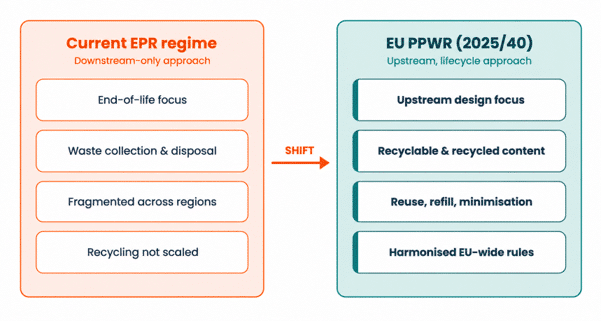
EPR is highly localised, while the EU Regulation 2025/40 harmonises the standards and makes them evidence based. What they share is a direction: greater producer responsibility and a closer link between EPR, waste management, and circularity.
Why Global Businesses Should Pay Attention

Related Read: Why Supplier ESG Is Becoming a Business Imperative
The impact of the EU Packaging and Packaging Waste Regulation will travel beyond the geographical boundaries of Europe to impact global businesses in more than one way. Exporters of packaged goods to the EU, Indian manufacturers serving European customers, and packaging manufacturers supplying EU-bound products will encounter its requirements, often first through customer questionnaires, supplier audits, and contractual specifications.
Additional challenges include:
- Managing multiple and evolving packaging regimes at once
- Expanding capabilities for regulatory mapping and packaging data management across markets
EU Packaging and Packaging Waste Regulation and Indian Business Leaders
Indian companies may find themselves answering a new set of questions on the recyclability of the plastic used in packaging ahead of the next shipment. These questions are coming from European buyers tightening supply chain requirements with the EU Regulation 2025/40 coming into effect.
Indian companies will experience changes whether they are:
- Selling packaged goods directly in the EU market.
- Supplying components, private-label goods or contract-manufactured products to European counterparts.
- Supplying packaging materials (films, cartons or components) into EU-bound supply chains.
EU PPWR compliance for exporters requires Indian suppliers to meet their own EPR obligations.
EU PPWR vs India EPR Packaging: From Plastic EPR towards Packaging Circularity
The EU and India have taken different regulatory routes, but their destinations increasingly overlap.
| Dimension | EU Regulation 2025/40 | India EPR |
|---|---|---|
| Regulatory approach | Single, directly applicable regulation covering the full packaging lifecycle | Plastic waste rules and EPR guidelines, evolving through amendments |
| Waste prevention | Explicit focus on recyclability and reusability of packaging material focused on minimization of waste | Growing focus, alongside restrictions on certain single-use plastic items |
| EPR | One of the pillars within a wider framework | Central compliance mechanism for plastic packaging |
| Recyclability and recycled content | Design-for-recycling and recycled-content requirements | Establishes recycled-content requirements for specified plastic categories |
| Reuse and refill | Strongly emphasised | Emerging, largely enabled through EPR pathways |
| Restrictions | Restricts specified formats and uses | Mostly regulates single-use plastic items |
| Information and data | Sets clear expectations for labelling, information, and traceability expectations | Registration, reporting and documentation through the EPR portal |
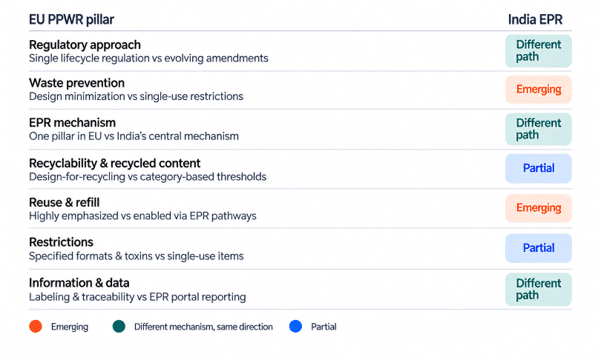
The two frameworks are not identical in structure, but they are moving in a broadly similar direction — toward prevention, recyclability, recycled content, and better data, not just downstream waste management.
Where the Change Will Actually Happen
For Indian companies, the transformation due to the EU Packaging and Packaging Waste Regulation will be reflected in:
- Recycled content evidence shifting sourcing and procurement from a cost conversation to a traceability one.
- Scrutiny of certain packaging materials (laminates, mixed-material pouches, non-recyclable coatings) prompting Indian exporters to reassess packaging portfolios against applicable EU Regulation 2025/40 requirements.
- Restrictions on excessive packaging, requiring design optimisation.
- Harmonised labelling rules making marking, documentation, and data part of packaging design.
- Indian companies’ own compliance becoming essential to supporting EU customers’ obligations.
From EPR Compliance to Packaging Circularity

This is where leadership makes a difference. Companies already making this move are advancing in the following directions:
Shifting focus
Treating packaging as a cross-functional issue rather than a compliance line item. Mapping a packaging portfolio, identifying materials, formats, components, quantities, suppliers, and markets.
Getting ahead of customer questionnaires
Understanding what applies across the EU, India, and other key markets.
Prioritising supplier-level packaging data
Tightening data collection and management at the source. Building reliable channels and gathering information on composition, recycled content, recyclability, and volumes.
Review existing processes
Testing existing materials against evolving guidelines, defining the evidence required from packaging and material suppliers, and exploring redesign opportunities.
The Larger Point
The packaging regulation has quietly rewritten its own purpose. It has shifted from asking how best to handle waste to asking a design question: Why does this packaging exist in this form at all, and could it exist better?
The EU Packaging and Packaging Waste Regulation makes that shift binding. The trajectory is clear: waste management → EPR → packaging design → circularity. For Indian businesses, this is not a distant European development to monitor from afar. EU importers carry obligations that flow backwards through their supply chains. India’s own EPR framework, evolving steadily from plastic waste rules towards broader circularity thinking, shares the same underlying direction even as its mechanics differ. Companies that act early, invest in reliable packaging data and embed circularity into everyday decisions will not only meet requirements but also contribute to a more resilient supply chain.
Why Choose Ascentium India?
As the EU Packaging and Packaging Waste Regulation pushes companies to rethink packaging, Indian companies need more than just a checklist. They require a structured approach to map material, trace recycled content, and build supplier data systems that hold up to scrutiny. Ascentium India’s ESG services help companies to exactly navigate this transition, regulatory mapping with EU PPWR compliance for exporters, Extended Producer Responsibility packaging rules, and packaging data management and reporting. By partnering with us, businesses can move beyond reactive compliance towards proactive circularity, turning packaging from a regulatory burden into a strategic differentiator. To learn more about our services, please email us at in-info@ascentium.com or reach out to us via WhatsApp at (+91) 77380 66622.