




































Globally, climate change threatens long-term economic prosperity and livelihoods. The financial sector in Hong Kong also faces increasingly severe impacts from climate change risk arising from extreme events such as sea-level rise, typhoons, and tsunamis, and pressure from global commitments to transition. The Hong Kong Monetary Authority, also known as HKMA, is consistently working to build a robust and resilient national regulatory framework on ESG and climate risk.
In 2019, Hong Kong’s greenhouse gas emissions were 40.1 million tons of CO2e, down 2% on a year-on-year basis. The major source of emissions was electricity generation, amounting to 65.70% followed by the transport sector (18.10%) and the waste management system (7.30%).
What is Climate Risk and Climate Change Risk Management?
Climate change risk refers to the potential negative impacts on the environment, society, and governance system caused by climate change, and it can be divided into three main categories.

- Physical risks refer to the direct effects of climate change on tangible assets and activities/operations. The statistics depict that 32% of Hong Kong’s property-related lending is focused on climate-vulnerable zones, and that devaluation losses exceed 50% in some extreme scenarios.
- Transitional risks arise from the risk associated with transitioning to a lower-carbon economy. It includes four main factors: technological changes, market adjustments, reputational risks, and policy shifts. Transitional risk would lead to increased credit exposure, a noticeable decline in the bank’s capital position, liability risks, and legal exposures arising from climate change-related claims.
- Liability risks include emerging legal risks related to climate change. It includes those looking for compensation from financial institutions accountable for losses and damages brought on by climate change that fund businesses engaged in activities that cause negative impacts on the environment.
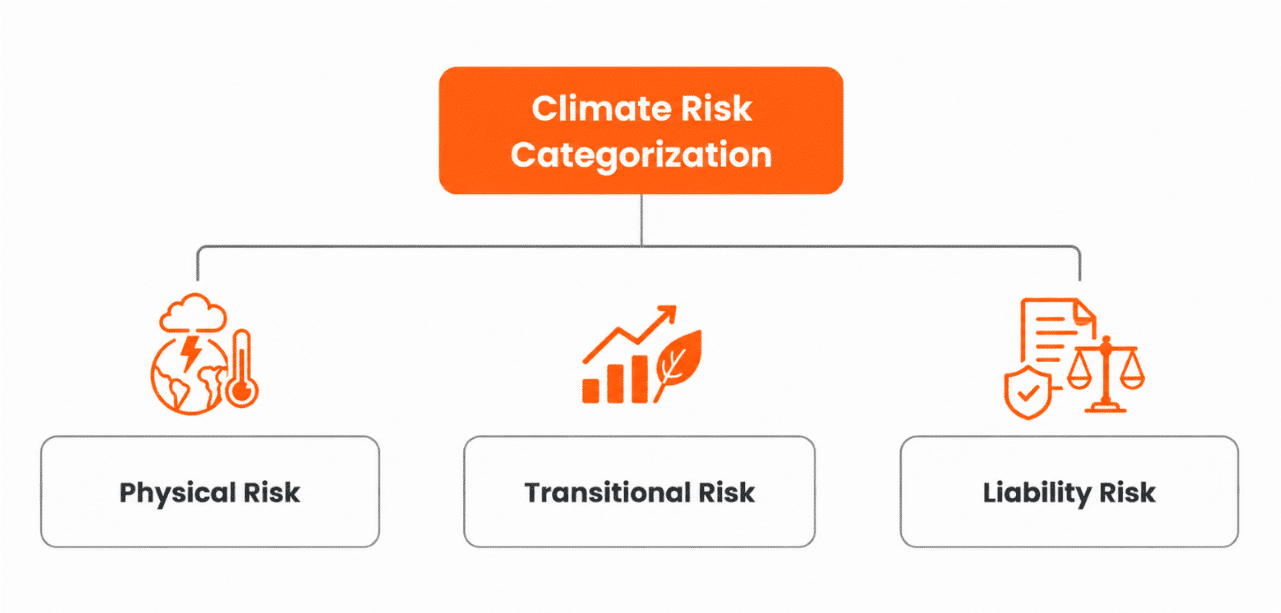
Climate risk Management categorization based on HKMA
Climate Change Risk Management Profile of Hong Kong
Hong Kong SAR has already begun to experience the effects of global warming, and the trend is expected to continue. The annual mean temperature in the Hong Kong region has risen by 0.14 °C per decade from 1885 to 2023. The acceleration is around 0.30 °C per decade from 1994 to 2023, with projected increases of about 1.2 °C to 3.6 °C. The dense urban building environment intensifies this warming trend due to the urban heat island effect.
The average rainfall has also increased, with 2023 recording the heaviest rainfall in the city. Deteriorating air quality and increasing population density escalate the threatening impact on health, the environment, and well-being.
The mean sea level around Hong Kong is also rising at the rate of 0.03m per decade during 1954-2023. Future projections forecast an expected rise of 0.4 to 0.8m under the median projection of the mean sea level by 2100. This will further increase the occurrence of severe storm surges, cyclones, and typhoons, posing a risk to coastal infrastructure, population residing in low-lying areas, and climate risk management practices. They pose huge economic losses and damage to property, productivity, business interruptions, operations, and human life.
Climate and Weather Risk Research, 2025, shows ~37-56% of properties owned by Hong Kong’s top four developers are at risk from climate change events such as storm tides, with 18% of one developer’s assets potentially submerged under sea by 2070 due to a one-meter sea level rise.
Regulatory Climate Risk Management Frameworks set by the HKMA
The HKMA has been focusing on climate risk management since 2019. In 2021, it issued the Supervisory Policy Manual (SPM) module GS-1, which provides guidance to authorized institutions on new regulatory requirements and supervisory expectations. This mandates banks to integrate ESG and climate change risk management through TCFD, NGFS, and Basel standards into governance, strategy, climate change risk management, and set disclosures.
In 2022, a detailed two-year plan was developed to integrate climate change risk management into banking supervision. It focuses on how banks can manage climate risks by leveraging green finance and adopting sustainable financing practices in Hong Kong.
The HKMA has drawn upon the work of TCFD, Network of Central Banks and Supervisors for Greening the Financial System (NGFS), and the Basel Committee on Banking Supervision to develop its approach to climate-related risks. It classifies climate change-related risks into both physical and transition risks, with an additional category of liability risks.
The HKMA published the Hong Kong Taxonomy for Sustainable Finance (Hong Kong Taxonomy) in early May 2024 as a green classification system to help the local market make informed decisions on green finance in Hong Kong and sustainable finance.
Hong Kong SAR has built a detailed three-pronged climate strategy called the Climate Action Plan 2050, which targets climate mitigation, adaptation, and building resilience. It sets an ambitious goal to reduce carbon emissions by 50% (relative to the 2005 level) before 2035. It also aims to achieve carbon neutrality before 2050 by utilizing renewable energy, improve energy efficiency, and reduce reliance on fossil fuels, along with stringent policies.
Strategies to Incorporate Climate Risk Management into Nations’ Climate Change Risk Management Framework
Hong Kong must adopt strategies, such as elevated infrastructure, flood-resistant design, and green infrastructure, to mitigate financial, reputational and insurance-related risks.
In 2025, HKMA utilized a climate risk management tool to undertake a climate risk stress test (CRST 2.0), evaluating 46 major institutions representing over 90% of the banking sector’s total lending against climate and economic risks, projecting a decline of 1.4 to 3.1 percentage points in the total capital ratio.

Related Read: Why Supplier ESG Is Becoming a Business Imperative
HKMA acknowledged the strong stress testing capabilities of institutions and identified emerging good practices in data collection, model governance, and technological application. Providing supervisory guidance under the Sustainable Finance Action Agenda, with special focus on optimising the integration of climate change risk management for more resilient assessments.
Climate risk management, opportunities and policy shifts: 73% of the Hong Kong investors have now recognized the financial materiality of climate change. Around 72% of the investors have integrated climate considerations into their investment policies.
Publications of climate-related investments and disclosures: 50% of Hong Kong’s investors are now publishing climate-related disclosures and climate scenario analysis that are well-aligned with the international benchmark and frameworks.
Climate Solutions & Transition/Green Finance: 17% of Hong Kong’s investors have a set target or disclosure on climate solutions investments, including transition investments, green finance, and scaling up low-carbon solutions.
Portfolio Emissions Reduction Target: 23% of Hong Kong investors have set near-term climate goals. Setting up robust interim targets and long-term goals forms the basis for investor transition plans and near-term strategy building.
HKMA engages with the industry to support the sector’s capability building to manage climate change risks. It helps banks strengthen capabilities to meet supervisory expectations on managing climate risk, explore possible solutions to resolve challenges, collect the industry’s feedback, enhance scenario specifications, develop climate-related stress tests, and explore opportunities to collaborate overseas.
The country also focuses on community engagement, public education, and the development of comprehensive preparedness measures to ensure that the population is well-equipped to face the challenges of changing climate.
Outlook and Trends for Hong Kong Climate Risk Management
Hong Kong’s government has prioritised infrastructure as a cornerstone of climate adaptation. They have allocated HK$3.7 billion for the Northern Metropolis and Hetao Co-operation Zone projects in 2025-26. They are designed to enhance connectivity while incorporating sustainability features like green roofs and renewable energy systems. Over the next two decades, the focus of investment will be on climate mitigation and adaptation, targeting decarbonization in electricity, buildings, transport, waste sectors, and green finance.

The Hong Kong Green Finance Association has identified six target sectors for green finance technology investment, mainly energy, environment and waste, building and construction, transportation, manufacturing, and fintech.
The IA and Hong Kong Federation of Insurers also collaborate and partner with academia and government to reform the Environmental Impact Assessment system, ensuring climate commitments are explicitly integrated into major projects of the country.
The current share of renewable energy remains less than 1% in the electricity fuel mix, significantly lower than the global average. The government aims to increase the share of renewable energy to 7.5-10% by 2035 and to 15% by 2050. Hong Kong has earmarked a total of $3 billion to install renewable energy facilities at government buildings and infrastructure since 2017-18. As of 2024, about $2.2 billion has been approved for more than 250 projects, including the installation of solar energy generation systems at government offices, schools, recreational grounds, and others.
Conclusion
Hong Kong has identified various decarbonization strategies to combat climate change and achieve its set carbon neutrality targets. These strategies include achieving net zero electricity generation, promoting energy-saving measures, green building, green transport, and implementing waste reduction measures.
The HKMA’s development of green taxonomy and physical risk assessment platform will support green finance/transition, enabling institutions to classify portfolios based on sustainability and identify high-risk investments. Its proactive governance, infrastructure investments, and insurance solutions show its strategic shift toward future resilience and adoption of a climate change risk management framework.
Why Choose Ascentium India?
Ascentium India helps financial institutions and businesses in Hong Kong navigate evolving climate risk management and disclosure requirements with practical, compliance-focused solutions. We integrate climate risk management with finance, governance, and business strategy to support HKFRS-aligned, audit-ready reporting. Combining regional expertise with global best practices, our team enables organizations to strengthen governance, enhance climate resilience, and achieve regulatory readiness through practical implementation rather than theoretical guidance. To learn more about our services, please email us at in-info@ascentium.com or reach out to us via WhatsApp at (+91) 77380 66622.